October 1, 2026
Tub to Shower Conversion Cost in New England
A tub to shower conversion in a standard 5 by 8 bathroom takes 5 to 9 days. The price swings on the plumbing, the waste line, and the floor you are working on.
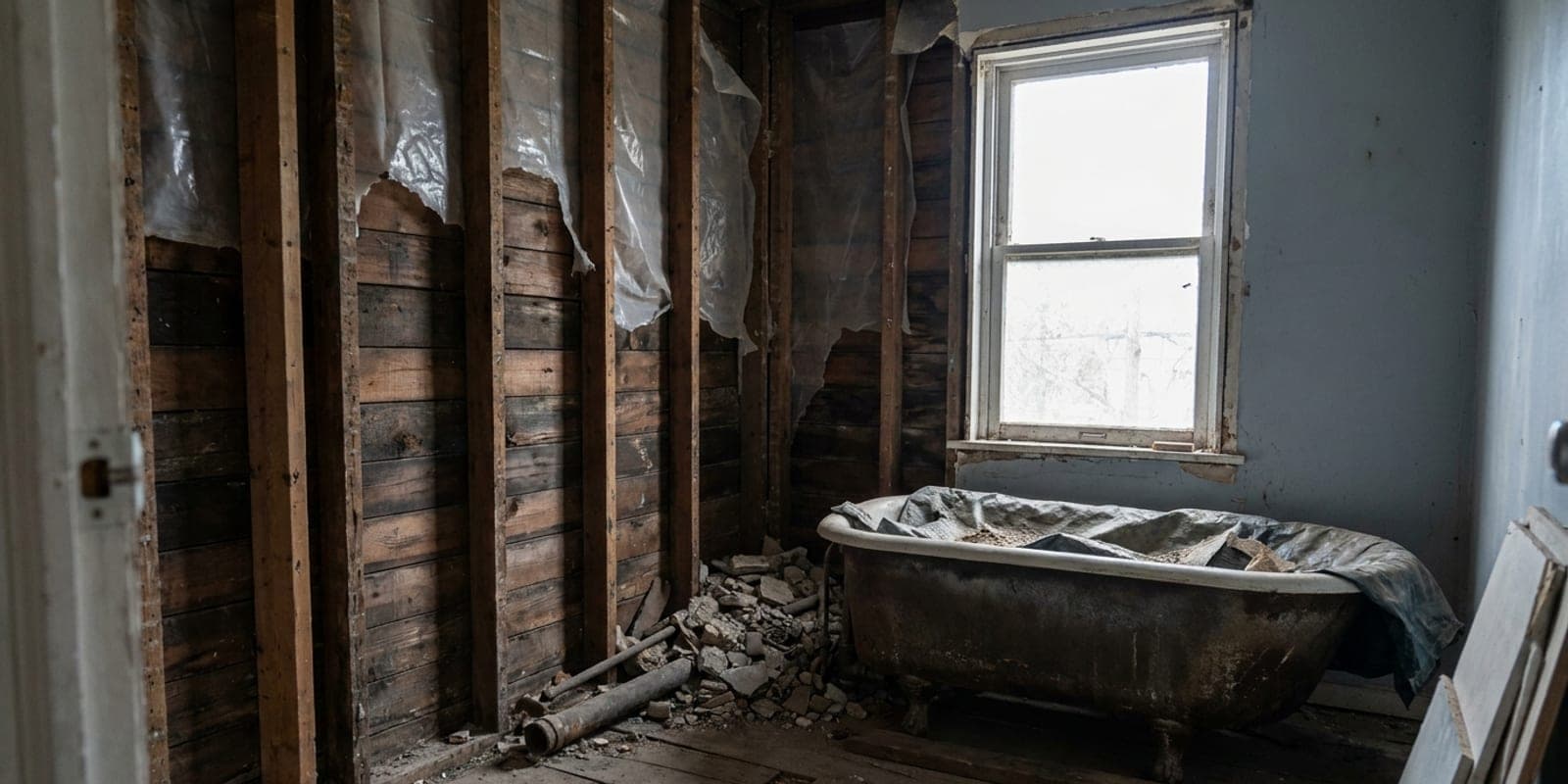
A tub to shower conversion in a standard 5 by 8 bathroom takes 5 to 9 days. The base cost is lower than most people expect. The final cost depends on three things that are hard to see from the doorway: whether the plumbing moves, what the waste line is made of, and what is behind the wall.
What the project is
You take out the alcove tub and its surround, and put a shower in the same footprint. A 5 by 8 bathroom, 40 square feet of floor, is the standard in a postwar Cape, and the alcove tub is five feet long on the short wall. The shower that replaces it is roughly 60 inches by 32 inches.
The work is demolition, a new waterproofed shower base or pan, wall tile or panels, a glass panel or curtain rod, and a new valve and trim. If the existing tub is a cast iron unit, demolition takes extra time, because it has to be broken up in the room and carried out in pieces. A cast iron tub can weigh 300 pounds or more.
Most of the scope is in the wall. This is why it is useful to know what is behind it.
The base cost, and the numbers that move it
Costs are estimates for this market, not quotes.
The starting point for a tub to shower conversion in a standard 5 by 8 bathroom, mid-range finishes, with the fixtures staying where they are, is roughly 9,500 dollars at a Massachusetts baseline. The timeline for that job is 5 to 9 working days.
From that baseline, these are the adjustments that apply most often:
Bathroom size. A bathroom under 40 square feet prices roughly 15 percent lower. A 60 to 100 square foot bathroom prices roughly 30 percent higher, mostly because there is more floor, more wall, and more tile.
Finish level. Builder-grade materials come in about 20 percent below mid-range. High-end tile, glass, and fixtures run roughly 55 percent above.
Plumbing. If the valve stays where it is, there is no adjustment. A minor move inside the same wall adds about 1,800 dollars. Relocating fixtures adds about 5,500 dollars, and it can add days.
Waste line. If the drain is cast iron, expect about 1,600 dollars on top, because the connection is harder to make. If the supply is galvanized pipe, it often has to be replaced, which adds about 2,400 dollars.
Second floor. A bathroom upstairs adds about 900 dollars, mostly for carrying material and debris and protecting the stairs.
Put those together and the range holds up. The same 5 by 8 bathroom with mid-range finishes and a minor plumbing move comes to about 11,300 dollars. With a full fixture relocation, a cast iron waste line, and a second floor location, the same job is closer to 17,500 dollars. On a typical project, the range runs from about 8,000 dollars at the bottom to about 16,000 dollars at the top, with the plumbing as the largest single swing.
What this costs in your part of New England
Labor rates differ across the three states and inside each one. The calculator on this site uses a state factor of 1.0 for Massachusetts, 0.97 for Connecticut, and 0.94 for Rhode Island, and then a regional factor on top. That produces numbers like these for the same 9,500 dollar baseline job:
Central Massachusetts, the area around Worcester, applies a factor of 0.94, which puts the baseline at roughly 8,900 dollars.
Greater Boston applies 1.22, which puts it at roughly 11,600 dollars.
In Rhode Island, Providence Metro applies the state factor of 0.94 and a regional factor of 0.98, which brings the baseline to roughly 8,800 dollars.
In Connecticut, Fairfield County applies 0.97 and 1.28, which is where the baseline reaches roughly 11,800 dollars.
The numbers are a way of seeing the shape of the market, not a promise about any particular bid. A house built before 1940 adds around 8 percent, and a house built before 1900 adds around 14 percent, because every open wall holds a surprise.
The surprises, and why they matter
Three things come up repeatedly in older housing in this region.
Rot behind the old surround. A fiberglass or tile surround hides the studs. Leaks at the valve, the tub spout, and the caulk line around the edge run water into the wall for years. When the surround comes off, the studs and subfloor at the tub end are sometimes soft. Replacing a few studs and a patch of subfloor is a modest job, but it has to be done before anything is waterproofed, and it is the most common reason a conversion runs a day or two over.
Old plumbing. Houses built between the 1920s and the 1960s often have galvanized supply pipe, which is corroded on the inside and restricts flow, and cast iron waste. A plumber working at the valve will tell you quickly whether the pipe is going to survive being moved. This is where the 2,400 and 1,600 dollar adjustments come from.
A floor that is not level. A shower pan needs a flat surface. In a house that has settled for a hundred years, the floor at the tub end is rarely flat. Leveling it takes time.
Walk-in versus curb: a decision that affects the price
A low curb of four inches or less is the standard conversion. A true barrier-free walk-in shower, where the floor slopes to a linear drain with no curb at all, costs more, mostly because the floor has to be recessed. On a first floor over a crawlspace or basement that is feasible. On a second floor it usually means opening the ceiling below. The accessible conversion in the calculator carries a base of about 16,000 dollars and a timeline of 7 to 14 days.
Is it worth doing?
For resale, a mid-range bathroom remodel in the Northeast recoups roughly 66 percent of its cost in the data used by the ROI calculator. A tub to shower conversion in a house with a second full bathroom that still has a tub is a different case, since buyers with young children often want one. If the house has only one bathroom, take out the tub only if you are sure.
If you are staying in the house and a step-over tub has become a problem, there is no resale argument. Do it.
How to compare bids
Ask each contractor to name the waste line material they expect and what they will do if the subfloor is soft. A bid that does not mention either is a bid that will change. Ask whether the price includes the waterproofing system, since a shower built without a proper membrane is a common reason a shower leaks inside the wall a few years later.
Ask whether a plumbing permit is pulled, and who pulls it. The requirement and the process vary by town, so check with your building department. Rhode Island, Massachusetts, and Connecticut each have their own state plumbing rules. If you are in Massachusetts, see the Massachusetts page for how permitting works across the state.
Next step
The bathroom remodeling guide covers every bathroom project type and what each one involves. If you are weighing a conversion against a full remodel, the sub-service pages break out the differences. And if you want quotes from contractors who work in your town, the free estimate form takes a couple of minutes and carries no obligation.