Service
Roofing across Rhode Island, Massachusetts, and Connecticut
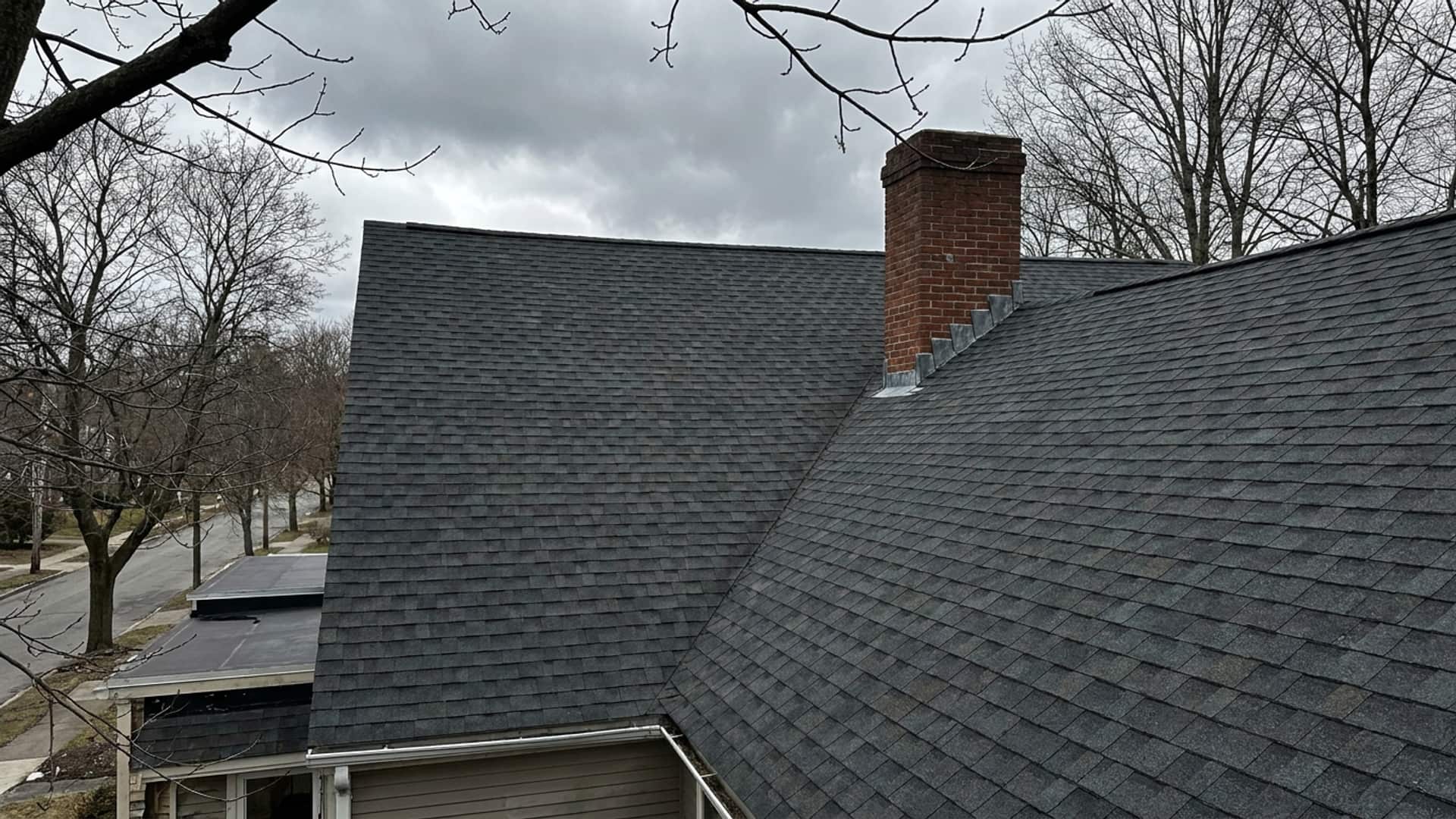
Most roof leaks in this region are not shingle failures. They are flashing failures at a chimney, a valley, a sidewall, or a vent boot, and they happen on roofs with years of life left. Knowing which problem you have is the difference between a 900 dollar repair and a 20,000 dollar replacement.
What a replacement actually involves here
A full tear-off removes the existing shingle down to the deck, replaces any sheathing that has failed, and rebuilds the roof as a system: ice and water shield at the eaves and in the valleys, synthetic underlayment over the field, drip edge, flashing at every penetration, shingle, and ridge venting. Every one of those layers has a failure mode, and the cheap version of the job is usually cheap because one of them was skipped.
The item that moves the number most on older housing is what is under the shingle. On anything built before roughly 1950 the sheathing is typically board rather than plywood, laid with gaps, and after a century of movement some of those boards are split, cupped, or rotted at the eave. You cannot see that from the ground and neither can the person quoting. A quote that carries a written deck allowance, something like 20 percent of the area at a stated dollar rate per square foot, is a quote from someone who has done this before. A quote with no deck line is a change order waiting to happen on day two.
Ice and water shield is not optional in this climate. It is a self-adhering membrane that seals around the nails driven through it, and it is the only thing standing between a backed-up ice dam and your ceiling. It should run at least six feet up from the eave, further on a low-eave cape or anywhere with a history of staining on the ceiling below, and it belongs in every valley and around every chimney regardless of what the minimum says.
The same roof job, four different houses
On a Providence or Worcester triple-decker, the main roof is rarely the problem. The leak is over the rear ell or the back porch stack, where the pitch drops below what asphalt shingle can handle and somebody shingled it anyway. That section needs EPDM or modified bitumen and a proper transition where it meets the main plane. Price the two areas separately, because a bid covering only the pitched roof has not covered the part that is leaking.
On a postwar cape in Warwick or East Providence, the eave sits seven or eight feet off the ground and the ice dam risk concentrates in that short run. The fix is almost entirely in the attic: air sealing the ceiling plane, getting insulation to a real depth, and balancing soffit intake against ridge exhaust. A new roof over an unchanged attic gets you a new roof and the same ice dams next February.
On a Victorian, you are not buying one roof. You are buying a main plane at 10:12 or steeper plus turret, dormer, porch, and bay sections, and every junction between them is a valley or a sidewall. Count the planes before comparing quotes, because a bid assuming three planes and a bid assuming seven are not comparable numbers.
On a coastal cottage in Westerly, Narragansett, or down the Connecticut shoreline, the fastener matters more than the shingle. Electro-galvanised nails corrode in salt air and the shingle stays put until the nail head fails, at which point a section lifts in one piece during a nor'easter. Stainless or hot-dipped galvanised costs very little more across a whole roof.
Materials, and what the difference actually buys
Architectural asphalt is the regional default and deserves to be. It runs roughly 5.25 to 7.50 dollars a square foot installed, carries a 110 to 130 mph wind rating, and lasts 25 to 30 years. Three-tab, at 4.00 to 5.50, saves maybe 15 percent and gives up ten years of life and half the wind rating. That trade rarely makes sense, and three-tab is barely specified now outside of rental turnover.
Premium architectural at 7.00 to 9.50 buys a heavier mat, a 130 mph rating, and 30 to 40 years. Worth it on a steep roof you do not want to stage again, or in an exposed coastal location. Not worth it on a low ranch roof you can reach from a ladder.
Standing seam metal runs 14.00 to 20.00, lasts 50 years or more, holds a 140 mph rating, and sheds snow well, which matters on a roof that sits under a persistent ice dam. The cost is roughly three times asphalt, so it makes sense as a permanent decision on a house you are keeping, not as a value play.
Synthetic slate at 18.00 to 26.00 is usually a historic district answer. It reads correctly on a Federal or a stone colonial where architectural asphalt looks wrong, and it is far more likely to be approved than asphalt where there is design review. Real slate repair is specialty work and replacing a slate roof with asphalt on a house framed for slate is usually a mistake, both visually and structurally.
EPDM at 7.50 to 11.00 is not an alternative to any of the above. It is the correct material for the low-slope sections that show up constantly in this region: rear ells, porch and piazza roofs, dormer tops, and additions. Most urban New England roof leaks start on one of those.
What drives the price
Five things, roughly in order. Surface area, which is footprint multiplied by a pitch factor, so a 10:12 roof carries about 40 percent more material than its footprint suggests. Pitch itself, because anything above 7:12 needs staging rather than a ladder. Deck condition, which is the unknown. Complexity, meaning the count of planes, valleys, dormers, and penetrations. And layers, since tearing off two layers instead of one adds roughly a dollar a square foot in labour and disposal.
Geography moves it too. The same roof costs noticeably more in Fairfield County or Greater Boston than in the Blackstone Valley or the Pioneer Valley, and on Block Island or Nantucket the material transport surcharge is real. Our roofing calculator applies those adjustments so you can see the number for your town rather than a national average.
How long it takes
A simple gable roof on a ranch or a cape is one to two days. A typical colonial with a few valleys and a chimney is two to four. A triple-decker with a rear ell and staging constraints is four to seven. A complex Victorian with multiple planes can run a week or more. Weather adds days, and no honest contractor opens a roof they cannot dry in before the next rain.
Permits are pulled by the contractor at the municipal building department, and inspection is against the state building code. That process is routine almost everywhere in the region and rarely drives the schedule. What does drive it, on a house under historic review, is approval of the material and sometimes the colour, which can add four to eight weeks before anything is ordered.
Roofing materials compared
Installed cost, how long it lasts, what it needs doing to it, and how it behaves within a mile of open water. No single material wins on every axis, and anyone telling you one does is selling it.
| Material | Per sq ft | Life | Maintenance | Coastal | Historic |
|---|---|---|---|---|---|
| 3-tab asphalt60 mph wind rating. Rarely specified now. | $4 to $5.5 | 15 to 20 yr | None | Fair | Sometimes |
| Architectural asphalt110 to 130 mph wind rating. The regional default. | $5.25 to $7.5 | 25 to 30 yr | None | Good | Sometimes |
| Premium architectural130 mph wind rating. | $7 to $9.5 | 30 to 40 yr | None | Good | Sometimes |
| Standing seam metal140 mph wind rating. Sheds snow well. | $14 to $20 | 50 to 70 yr | None | Excellent | Sometimes |
| Synthetic slate110 mph wind rating. Appropriate in a historic district. | $18 to $26 | 50 to 70 yr | None | Excellent | Usually approved |
| EPDM low slopeFor rear ells and porch roofs. | $7.5 to $11 | 20 to 30 yr | None | Good | Sometimes |
Massachusetts baseline before regional adjustment. Estimates for this market, not quotes. Compare these over the years you plan to stay, which is where the cheaper option stops being the cheaper option.
What drives the roofing price
Heaviest factor first. When two quotes differ by thousands, the difference is almost always in one of these six lines rather than spread evenly across the job.
| # | Factor | Typical effect | Why |
|---|---|---|---|
| 01 | Surface area | Largest single factor | Footprint multiplied by a pitch factor. A 10:12 roof carries roughly 40 percent more material than its ground footprint suggests. |
| 02 | Deck condition | Up to 3.40 dollars per square foot | Unknown until the old shingle is off. On pre-1950 board sheathing some percentage almost always needs replacing. |
| 03 | Pitch and access | 12 to 40 percent | Anything above 7:12 needs staging rather than a ladder, which is labour rather than material. |
| 04 | Plane count | 10 to 22 percent | Every valley, dormer, and sidewall is a flashing detail. A bid assuming three planes and one assuming seven are not comparable. |
| 05 | Material | 4.00 to 26.00 per square foot | Architectural asphalt is the regional default. Metal and synthetic slate are permanent decisions, not value plays. |
| 06 | Tear-off layers | Roughly 1.10 per square foot for a second layer | Two layers instead of one adds labour and disposal. |
Common questions
If the shingle is intact and the leak traces to a flashing detail at a chimney, valley, sidewall, or vent boot, repair. A roof with eight good years left and one bad chimney flashing does not need replacing, and anyone telling you otherwise is selling a roof. Replace when the shingle is curling or losing granules across the field, when there are multiple leaks in unrelated locations, or when the deck itself is failing.
Heat escaping into the attic melts the snowpack on the roof above it. The meltwater runs down to the cold overhang past the heated part of the house, refreezes there, and builds a dam. Water then backs up behind that dam and pushes up under the shingles, which are designed to shed water running down, not to hold water sitting still. It is an insulation and ventilation problem that presents as a roof problem, and a new roof alone will not fix it.
No. Gutters do not cause ice dams and guards do not prevent them. The dam forms on the roof surface at the cold eave, above the gutter, and would form there if the gutter were removed entirely. Anyone selling guards on that basis is selling the wrong product for the problem. Air sealing, insulation, and balanced ventilation are the fix.
For a typical single family with an 1,800 square foot footprint and architectural asphalt, the range across these three states runs roughly 11,000 to 24,000 dollars before adjusting for region and housing stock. A pre-1940 house adds around 8 percent for deck risk, a historic district adds more, and Fairfield County and Greater Boston sit well above the regional midpoint. The roofing calculator produces a figure for your town and your roof.
Before plywood became standard around 1950, roof decks were built from individual boards laid across the rafters with gaps between them. Those boards split, cup, and rot at the eave over a century. You cannot assess them until the old shingle is off, which is why a deck allowance belongs in the quote rather than in a conversation on the second morning.
Most codes allow two layers total. It saves roughly 15 percent on the job by avoiding tear-off and disposal. It also means nobody inspects the deck, the second layer traps heat and shortens the life of both, and the eventual tear-off costs more. On anything older than about 1950 it is usually a false economy, because the deck is exactly what needed looking at.
Within a mile of open water, a 110 mph architectural shingle is the practical floor and 130 is better. Wind uplift almost always starts at a rake edge or a ridge and works inward, so the edge details and the starter course matter as much as the rating on the bundle. Stainless or hot-dipped fasteners belong in the same specification.
Yes, for a replacement. Your contractor pulls it at the municipal building department and the work is inspected against the state building code. In a local historic district, material and sometimes colour need approval before anything is ordered, which is a separate process and can add four to eight weeks.
Roofing across all three states
Roofing is covered in Rhode Island, Massachusetts, and Connecticut. Pick a state for the local overview, or open a town to see the housing stock, the permitting authority, and a cost range for that market.
Roofing in Rhode Island
39 municipalities
Roofing in Massachusetts
351 cities and towns
Roofing in Connecticut
169 municipalities