October 1, 2026
Do Gutter Guards Actually Work Under New England Leaf Load
Under heavy oak and maple leaf load, most guard types still need clearing. Micro-mesh performs best, and no guard prevents ice damming or removes maintenance.
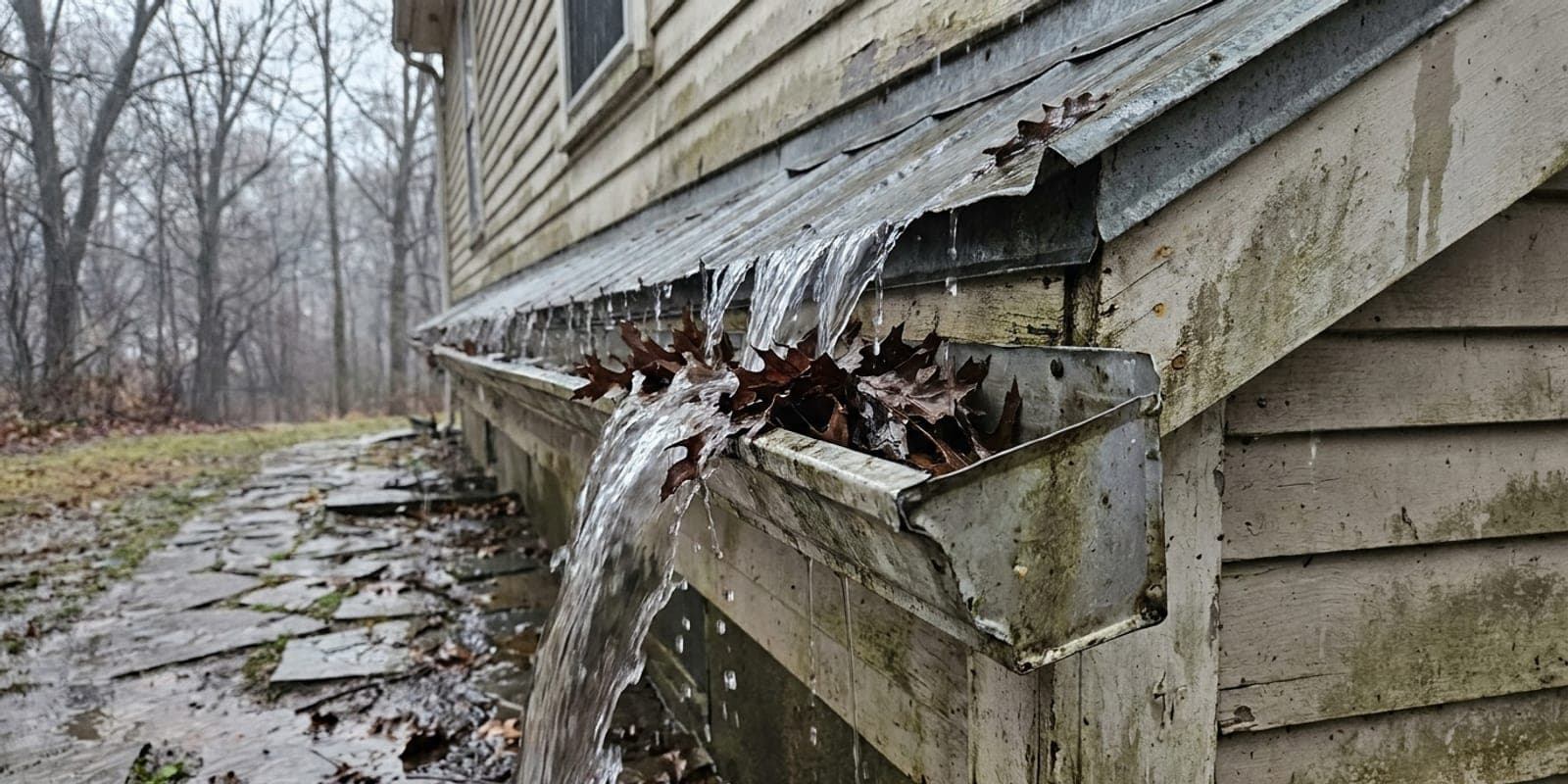
Under heavy oak and maple leaf load, most gutter guards still need clearing. Micro-mesh performs best. No guard removes maintenance, and no guard prevents ice damming. The marketing claims in this category are the least reliable in home improvement, so it is worth knowing what each type does before spending money.
What a guard is for
A guard sits over the gutter trough and lets water in while keeping debris out. The idea is that you stop climbing a ladder twice a year. The reality is that something still collects on top of the guard, or gets past it, and you still have to deal with it, only less often, if you chose well.
New England is a hard test for this. A mature lot with oaks and maples drops a lot of material. Maple leaves come down in October, flat and wet. Oak leaves fall later, often into November and sometimes hang on through the winter. In the spring, oak catkins drop in long strings. Pine needles, where there are pines, are thin enough to slip through most openings. Add the roof grit that washes off asphalt shingles and the seeds from maples, and the gutter collects more than almost any other region's.
The main types
Screens and perforated covers. Sheets of metal or plastic with holes, set into or over the trough. They are cheap. The holes are large, and small debris, seeds, and grit pass through and settle in the gutter anyway. Leaves can sit flat across the top and block the openings.
Reverse curve covers. A solid hood curves over the front edge of the gutter. Water follows the curve and drops into a slot, while leaves slide off. They work well on a steep roof where water moves fast, and poorly in a heavy downpour, where water can shoot past the slot. On a low-slope roof they are less reliable, and in winter ice can form on the hood.
Foam and brush inserts. Cheap and easy to install, and they clog. Pine needles and seeds lodge in them, and they often need replacing within a few years.
Micro-mesh. A fine stainless steel mesh, framed in aluminum, stretched over the trough. The openings are small enough to stop most debris, including pine needles and shingle grit. It performs best in this region. It is the most expensive, and it still collects a mat of leaves on top, which dries and blows off in many cases but not all.
What "maintenance-free" means in practice
On a lot with heavy oak and maple cover, expect to clear the surface of even a micro-mesh guard once or twice a year. A leaf blower or a soft brush on a long pole does it. It takes minutes, not hours, and you do not have to put your hands into wet leaf mold.
That is a real improvement over scooping a trough, and some owners find it worth the money. It is also not what the advertisements say.
Guards and ice dams
Guards do not prevent ice dams. Ice dams form at the roof edge because heat escapes from the attic and melts snow, and the meltwater refreezes at the cold overhang. That has nothing to do with the gutter. If anyone sells a guard on the basis that it will stop ice damming, they are wrong. The ice dam guide covers what does work.
Guards can also interact badly with ice. Frozen meltwater can lift a guard, and a hood over the trough can form a solid ridge of ice along the edge. In heavy snow country, such as the Berkshires, the Northwest Hills in Connecticut, and northern Rhode Island, ask whether the product has been used through a winter at your elevation.
Size the gutter first
The most common gutter defect on older New England houses is a 5 inch gutter on a roof plane too large for it. If the gutter overflows in a heavy rain, the problem is capacity, and a guard will make it worse, since it restricts the flow of water into the trough.
A 5 inch K-style gutter handles most roof planes. A 6 inch gutter is the right call on a large plane or a steep pitch, and the number of downspouts matters as much as the width. A long run with a single downspout at one end will overflow regardless of what is on top of it.
Before buying guards, watch the gutters during a hard rain. Where they overflow, fix the sizing and the downspout count. Then decide on the guards.
Cost
Costs are estimates for this market, not quotes.
Installed seamless gutter, around 180 linear feet with downspouts, a typical size for a colonial, runs roughly 1,500 to 5,200 dollars. Guards are an additional cost, and the range is too wide to publish a number that would be useful. It depends on the type, the length, and the roof. Micro-mesh costs more per foot than a screen. Ask for the guard as a separate line on any quote, so you can see what you are paying for.
If the existing gutters are in poor shape, the sensible order is to replace the gutters first and add guards at the same time, because the guards fit the new gutters and the hangers are accessible.
A cleaning routine that costs nothing
If you skip the guards, timing matters more than effort. Clear the gutters once after the maples are down, usually in late October, and again after the oaks, which can run into December. Do it before the ground freezes, so a full trough is not frozen solid for the winter. Check the downspouts by running a hose, because a clogged downspout looks like a clogged gutter. Look once more in late spring after the oak catkins drop. Three short visits a year keeps a standard gutter working, and it is also the moment to spot a sagging run or a loose hanger early.
Who should buy them
Buy them if the house has a tall roofline and tall trees, if access is difficult, if the gutters are above a porch roof that is hard to reach, or if getting up a ladder is a risk for you. In those cases the cost of the guard is less than the cost of the service call.
Skip them if you are comfortable on a ladder, the gutters are within easy reach, and the lot has few trees. A cleaning in late fall and again in spring costs very little.
Be careful if the house has a history of ice damming. Fix the attic first. A guard will not hide the problem.
Questions to ask a contractor
What is the guard made of, and what are the opening sizes?
Is it installed under the first course of shingles, or clipped to the gutter lip? Under the shingles, it can raise questions with the roof manufacturer. Ask.
What is the warranty on the guard, and who stands behind it? The contractor does, since this site does not warrant the work.
Have you seen this product through a New England winter?
Next steps
The gutter guide covers installation, replacement, and guards, with the sizing and downspout rules that apply to older houses. The sub-service pages go into each. If you would rather get a price from contractors who work in your town, the free estimate form takes a few minutes, with no obligation.